
A good whole-body EMS session does not look dramatic. There is no need for a room full of heavy strength equipment, a frantic circuit or a trainer shouting for one more rep. What is happening is more controlled: the client performs simple voluntary movements while electrical impulses are applied across several major muscle groups at the same time.
That combination matters. EMS is not simply “putting on a suit and letting the machine exercise for you”. The client still braces, squats, hinges, presses, rotates, breathes and responds to coaching. The electrical impulse adds an external stimulus to the muscular work already being created by the movement. The trainer’s job is to bring those two inputs together at a level the client can control.
In a professional WB-EMS session, the client is an active participant. Simple exercises are chosen because they make it easier to maintain posture, create tension and give accurate feedback. A basic squat, for example, gives the trainer a clear movement pattern to coach while the glutes, thighs, trunk and other selected areas receive their individual impulse settings.
This is one reason experienced EMS coaches often prefer low impact uncomplicated movements. If the exercise itself is technically demanding, it becomes harder to tell whether the difficulty is coming from poor movement, fatigue, external load or the electrical stimulus. Simple patterns make the dose easier to control.
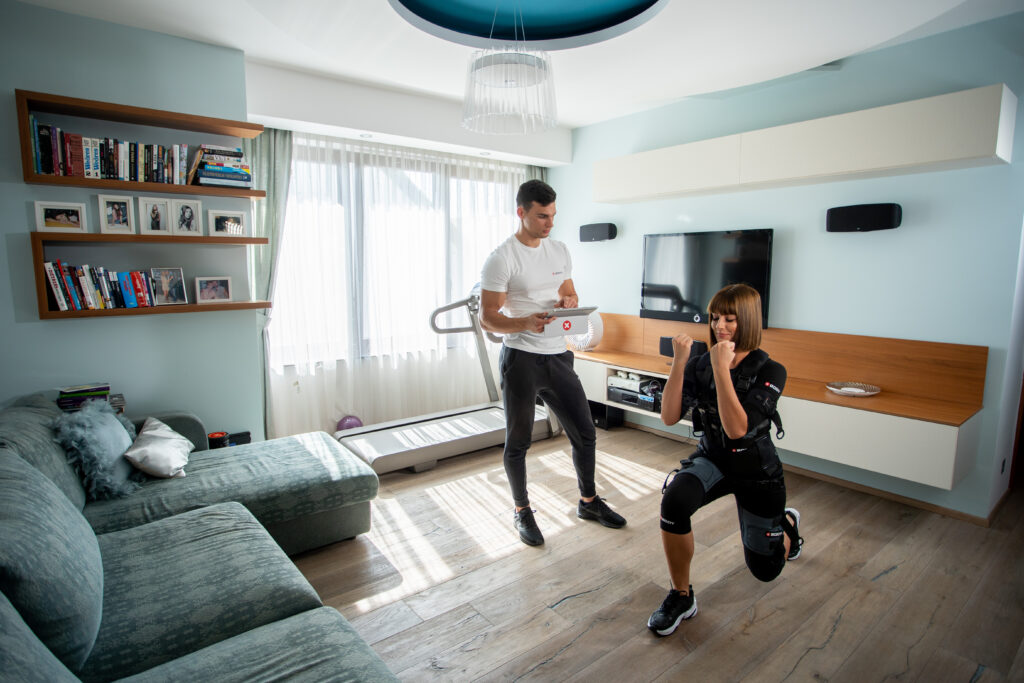
Whole-body EMS systems allow the trainer to adjust the stimulation delivered to different muscle regions. A client may comfortably tolerate a higher setting through the glutes than through the arms or abdomen. Treating every channel as though it should feel identical misses the point.
The coach progressively adjusts each area and asks for feedback. The sensation should be strong enough to create a clear contraction but remain controllable. “More” is not automatically “better”. The useful training dose is the one that matches the person in front of you, their training history and where they are in the session program.
The session is short because several large muscle regions can be loaded in parallel. In conventional resistance training, an exercise may focus mainly on one movement or muscle group before the client changes exercise. In WB-EMS, multiple regions can be stimulated during the same movement block.
It simply makes WB-EMS a different way to organise strength training: short, concentrated and efficient.
The device provides the technology; the trainer provides judgement. Screening, suit fit, exercise selection, per-channel adjustment, observation and constant communication all sit with the coach.
That is also why professional EMS should not be sold as a passive suit workout. A strong studio experience is built around a trainer who knows when to increase the stimulus, when to hold it, and when to stop. The best session is not the one with the highest numbers on the screen. It is the one the client can execute well, recover from and repeat consistently.
When a new client understands the method, the session usually becomes easier to coach. Explain that they are responsible for the movement and feedback, while the trainer controls the electrical stimulus and coaches correct technique. Ask them to report each body region rather than giving a single “fine” or “too much” answer.
Ready to take the next step? Thinking about adding professional EMS to your gym, PT business, physio practice or studio? XBody Australia supplies XBody EMS equipment across Australia and New Zealand and supports operators with training, setup and local service.
Editorial source notes
These sources support factual background and editorial checking. The article above is original copy and is not a rewrite of the source material.
• Kemmler et al. (2023), international WB-EMS safety guideline